
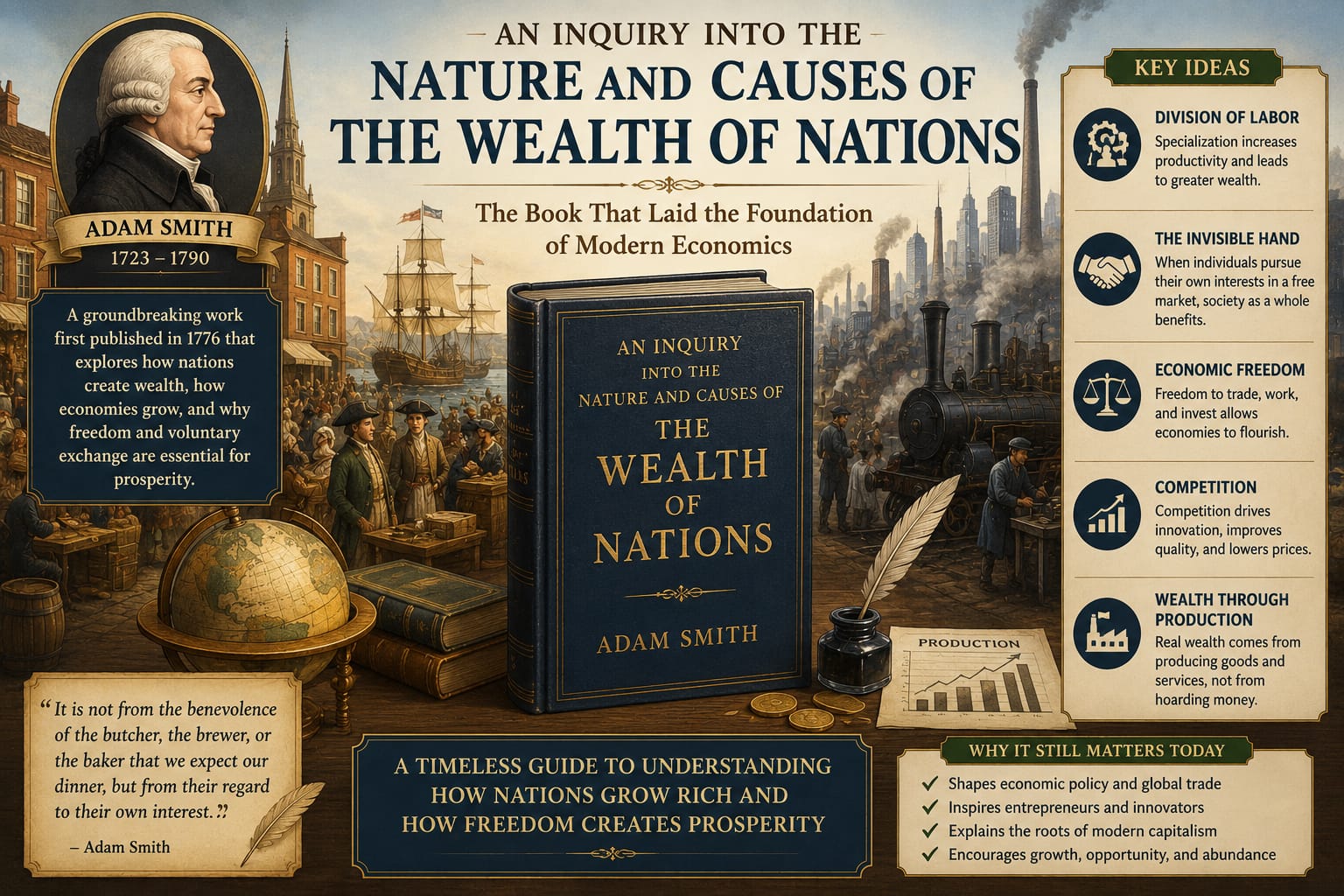
When discussing the most influential books ever written about economics, few works can match the impact of An Inquiry into the Nature and Causes of the Wealth of Nations. Published in 1776 by Adam Smith, this groundbreaking book laid the foundation for modern economic thought and continues to influence governments, businesses, and individuals around the world.
Often referred to simply as The Wealth of Nations, the book explores how nations create prosperity, how markets function, and why economic freedom plays a critical role in wealth creation. Although it was written more than two centuries ago, many of its ideas remain surprisingly relevant in today’s global economy.
In this article, we’ll explore the key concepts of this classic work, its lasting influence, and why it remains essential reading for anyone interested in economics, business, and wealth creation.
What Is The Wealth of Nations About?
At its core, The Wealth of Nations seeks to answer a simple but powerful question:
Why are some nations rich while others remain poor?
Before Smith’s work, many governments believed that a country’s wealth depended primarily on accumulating gold and silver. Smith challenged this idea and argued that a nation’s true wealth comes from its ability to produce goods and services efficiently.
According to Smith, productivity, specialization, free markets, and voluntary exchange are the primary drivers of economic growth.
His ideas revolutionized economic thinking and helped shape modern capitalism.
The Power of the Division of Labor

One of the most famous concepts introduced in the book is the division of labor.
Smith observed that workers become more productive when tasks are divided into smaller, specialized activities.
He illustrated this principle using a pin factory, showing how workers performing specific tasks could produce far more pins than workers attempting to make entire pins individually.
The benefits of specialization include:
- Increased efficiency
- Improved skills
- Faster production
- Greater innovation
- Lower costs
Today, the division of labor remains a fundamental principle in manufacturing, technology, healthcare, and virtually every modern industry.
The Invisible Hand: A Revolutionary Idea
Perhaps the most famous concept associated with Adam Smith is the idea of the “invisible hand.”
Smith argued that when individuals pursue their own economic interests within a competitive market, they often unintentionally benefit society as a whole.
For example:
- Businesses seek profits.
- Consumers seek value.
- Workers seek better wages.
Through voluntary exchange and competition, resources tend to flow toward their most productive uses.
The invisible hand does not suggest that markets are perfect. Rather, it highlights how decentralized decision-making can often produce efficient outcomes without central planning.
This concept remains one of the cornerstones of modern economic theory.
Free Markets and Economic Freedom

Another major theme throughout The Wealth of Nations is the importance of economic freedom.
Smith believed that individuals should generally be free to:
- Start businesses
- Choose occupations
- Trade goods and services
- Invest capital
- Compete in markets
He argued that excessive government restrictions often reduce innovation and economic growth.
While modern economists recognize the need for some regulation, Smith’s emphasis on free enterprise continues to influence economic policy around the world.
Countries that encourage entrepreneurship, innovation, and competition often experience higher levels of prosperity and economic development.
Competition Drives Progress

Smith viewed competition as an essential force for economic improvement.
When businesses compete for customers, they are motivated to:
- Improve quality
- Lower prices
- Develop new products
- Increase efficiency
Without competition, monopolies and inefficiencies can emerge, leading to higher costs and reduced consumer choice.
This insight remains highly relevant today as governments and regulators continue to address issues involving market concentration and corporate power.
The Role of Self-Interest

One of the most misunderstood ideas in the book is Smith’s discussion of self-interest.
He did not argue that greed is always good. Instead, he observed that people naturally seek to improve their own circumstances.
A baker provides bread not solely out of generosity but because selling bread supports their livelihood. Yet consumers still benefit by receiving the product they need.
This system of voluntary exchange allows both parties to gain value.
Smith believed that properly functioning markets could channel individual ambitions into broader economic benefits.
Why The Wealth of Nations Still Matters Today
Despite being published in the 18th century, many of Smith’s ideas continue to shape modern economies.
The book remains relevant because it addresses timeless issues such as:
Economic Growth
Policymakers still study how nations can increase productivity, create jobs, and improve living standards.
Global Trade
Smith strongly supported trade between nations, arguing that specialization and exchange benefit all participants.
Entrepreneurship
His ideas encourage innovation, risk-taking, and business creation.
Wealth Creation
The book explains how value is generated through productive work rather than simply accumulating resources.
These concepts continue to influence debates about taxation, regulation, trade, and economic policy.
Criticisms and Limitations
Although The Wealth of Nations is widely respected, some critics argue that certain ideas require modification in today’s complex economy.
Common criticisms include:
- Markets do not always operate perfectly.
- Economic inequality can increase without intervention.
- Environmental costs are sometimes ignored.
- Certain industries may require regulation.
Modern economists often combine Smith’s principles with additional insights from later economic research.
Even so, the book’s foundational contributions remain highly influential.
Key Lessons from The Wealth of Nations
Several enduring lessons stand out from Smith’s masterpiece:
Productivity Creates Prosperity
Economic growth depends largely on improving productivity and efficiency.
Specialization Matters
Individuals and businesses perform better when focusing on their strengths.
Competition Benefits Consumers
Healthy competition encourages innovation and lower prices.
Freedom Encourages Growth
Economic freedom often promotes entrepreneurship and investment.
Wealth Is Created Through Production
A nation’s prosperity comes from producing valuable goods and services, not merely accumulating money.
Final Thoughts
An Inquiry into the Nature and Causes of the Wealth of Nations remains one of the most important books ever written on economics. Through his analysis of markets, competition, specialization, and economic freedom, Adam Smith provided a framework that continues to influence the modern world.
While some aspects of economic theory have evolved since 1776, the core principles explored in this classic work remain remarkably relevant. Whether you’re a student, entrepreneur, investor, policymaker, or simply curious about how economies function, The Wealth of Nations offers valuable insights into the forces that drive prosperity.
More than two centuries after its publication, this landmark book continues to teach readers a powerful lesson: lasting wealth is created through productivity, innovation, and the freedom to exchange value in an open marketplace.
Wealth of Nations, Adam Smith, modern economics, economic growth, free markets, division of labor, invisible hand, capitalism, economic freedom, wealth creation, entrepreneurship, global trade, productivity, competition, economic theory.